Related Content
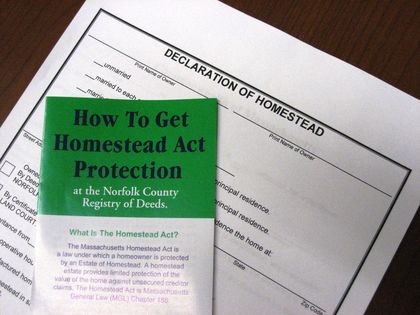
To receive a Homestead form - you may use the links below:
Click here to download Declaration of Homestead
Click here to download Declaration of Homestead Property Held in Trust
Click here to download Declaration of Homestead Elderly ~ 62+
The Homestead Act
Massachusetts General Laws Chapter 188, Sections 1 – 14
PLEASE NOTE: THIS MATERIAL IS INTENDED TO PROVIDE BASIC INFORMATION. IT IS NOT INTENDED AS LEGAL ADVICE.
AS IN OTHER AREAS OF LAW, TO FULLY UNDERSTAND YOUR RIGHTS YOU SHOULD CONSULT AN ATTORNEY.
Questions and instructions for filing a Declaration of Homestead:
1. What is the Homestead Act? The Massachusetts Homestead Act is a law under which a homeowner is protected by an Estate of Homestead. A homestead estate provides limited protection of the value of the home, up to $500,000, against unsecured creditor claims. The Homestead Act is Massachusetts General Laws (MGL) Chapter 188.
The homestead estate is designed to protect home ownership from execution and forced sale, so long as the owner or covered family member occupies or intends to occupy the property as his or her principal place of residence.
2. How is the Homestead established? Section 4 of MGL Ch. 188 provides an automatic exemption available to everyone who owns a home and who occupies or intends to occupy the home as his or her principal residence. This exemption is for $125,000.00. Filing a written Declaration of Homestead at the Registry of Deeds for the county where the home is located increases that amount to $500,000.00. There are two types of Homestead Declaration. The standard form of homestead declaration is filed under Section 3 of the Homestead Act. The second form is for elderly or disabled people and is filed under Section 2.
Section 2: An elderly (age 62 or older) or disabled person may declare a Homestead under Section 2. The Section 2 homestead benefit does not extend to other family members in general, but each qualified owner should file.
Section 3: A Homestead Declaration under Section 3 must be filed by the owners of a home for the benefit of their family. For property held in trust the trustee or trustees must file.
Under both sections the property must be occupied or intended to be occupied as a principal residence. The extent of the homestead protection is $500,000 under Section 3 but may be higher under Section 2.
3. What does the Homestead do? Upon filing a Declaration of Homestead, the homestead estate is exempt from attachment, execution or forced sale for payment of “non-exempted” debts.
4. What are the exempted debts? What debts are not protected against by a Homestead Declaration? The following are exempt from Homestead protection: federal, state and local taxes and liens; mortgages contracted for purchase of the home and most other mortgages; debts and encumbrances existing prior to the filing of the Declaration of Homestead; probate court executions for spousal or child support; attachments on land not owned by the owner of the owner of the homestead and court ordered executions in cases of fraud, mistake, duress, undue influence, and lack of capacity.
5. What information is required? The names of each of the benefitted owners and non-title holding spouses, if any, the property address, and the title reference of the property. The title reference is the Book and Page of the owner’s recorded deed, or the Owner’s Certificate of Title number if the property is Registered Land, or probate court docket number (for inherited property). No title reference is required for filings covering mobile or manufactured homes as well as cooperative housing units, unless there is evidence of a lease on record. All owners must sign the document and have their signatures notarized. The marital status of all owners must be stated. For a disabled person’s homestead declaration, a disability letter must be attached.
6. How does the Homestead Law define “disabled person?” A disabled person is defined as an individual having a permanent physical or mental impairment meeting the disability requirement for supplemental social security. If filing a disabled person’s homestead declaration, you must attach to the Declaration of Homestead form a certified copy of a disability letter issued by the United States Social Security Administration, or a letter signed by a licensed physician registered with the Massachusetts Board of Registration in Medicine that states the declarant is disabled as defined in 42 USC 1382 (a) (3) (A) and (C).
7. Is the amount of the Homestead calculated from the base value of the real estate or the equity above the mortgage or prior liens? The law is unclear on this issue. Recent court cases suggest that the Homestead applies to the equity above any exempted liens or encumbrances.
8. Do I have to file a new Homestead every time I re-mortgage or take out a second mortgage or home equity loan? NO. The new language which went into effect March 16, 2011 states that homesteads are subordinate to mortgages and that no language in a mortgage can affect a homestead except to subordinate it.
9. Is property held in trust eligible for homestead protection? Yes. Property held in trust can now reap the benefits of the Homestead Act. There is no mention of trust property being covered under the old law, but now it can be protected. On the form all benefitted owners (beneficiaries) must be listed, but only the trustee or trustees of the trust is required to sign the document.
10. Will my Homestead protect my home from being taken if I go into a nursing home? No. A lien imposed by the Office of Medicaid as a result of payment for Medicaid benefits, is a governmental lien and is exempt from Homestead protection.
11. Can I file a Homestead for my residence if it is a mobile or manufactured home? Yes. The Registry of Deeds has been authorized by the new law to accept a declaration of homestead for a mobile or manufactured home.
12. Where can I get the appropriate Homestead form? Declaration of Homestead forms can be obtained at the Norfolk County Registry of Deeds, 649 High Street, Dedham, MA 02026, or online here. You may also phone our Customer Service Center at 781-461-6101.
13. How much does it cost to file a Homestead Declaration? The fee is $36.00.
14. How do I file a Declaration of Homestead? The Declaration of Homestead may be filed in person or by mail. To file by mail in Norfolk County, mail the completed notarized declaration, together with a check for the amount of the fee ($36.00) payable to: Norfolk County Registry of Deeds
Mail to: William P. O’Donnell, Register
Norfolk County Registry of Deeds
ATTN: HOMESTEAD REQUEST
649 High Street
Dedham, MA 02026-1831
15. Other questions or additional information needed? Please stop by the Registry, email us at registerodonnell@norfolkdeeds.org or call our Customer Service Center at 781-461-6101 for further assistance.
To receive a Homestead form - you may use the links below:
Click here to download Declaration of Homestead
Click here to download Declaration of Homestead Property Held in Trust
Click here to download Declaration of Homestead Elderly ~ 62+
Forms are available at the Registry of Deeds, or to receive a form by mail, please call the Customer
Service Center at 781-461-6101.
The filing fee is $36.
To file a Homestead - For property located in Norfolk County, you may file your Homestead in person
at the Norfolk County Registry of Deeds or mail to:
William P. O'Donnell, Register
Norfolk County Registry of Deeds
ATTN: HOMESTEAD REQUEST
649 High Street
Dedham, MA 02026-1831
-Before mailing, be sure the form is filled out completely and has been properly notarized.
-Remember to enclose a check for the proper recording fee.
-The check should be made payable NORFOLK COUNTY REGISTRY OF DEEDS in the amount of $36 (thirty-five dollars plus one dollar postage and document return).